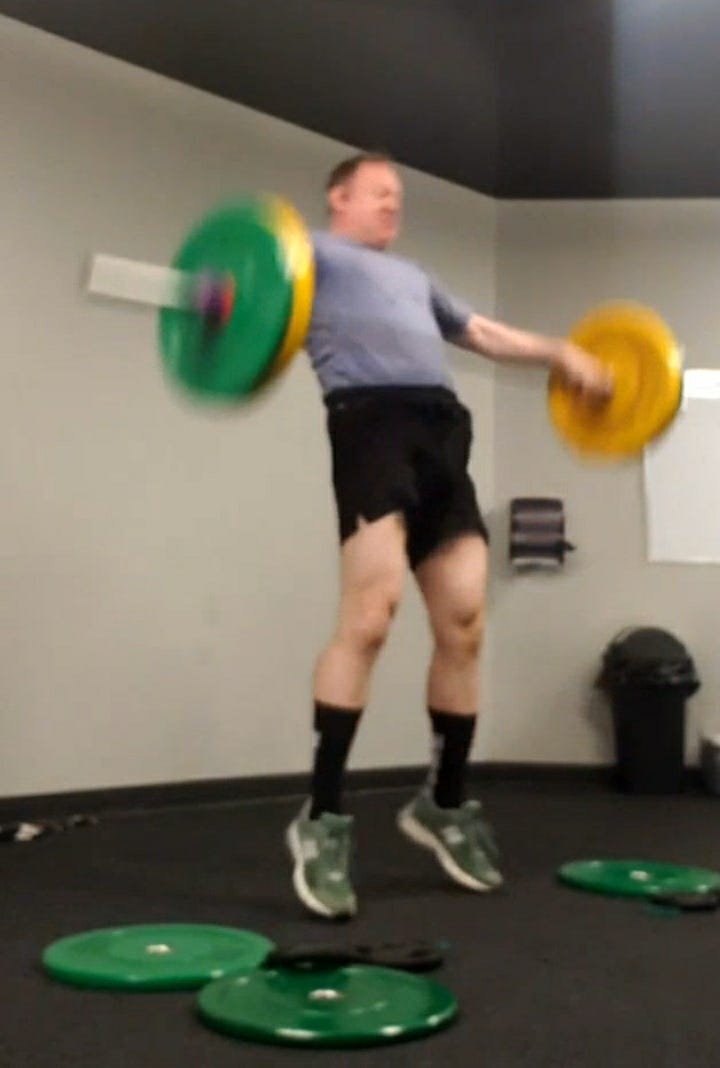
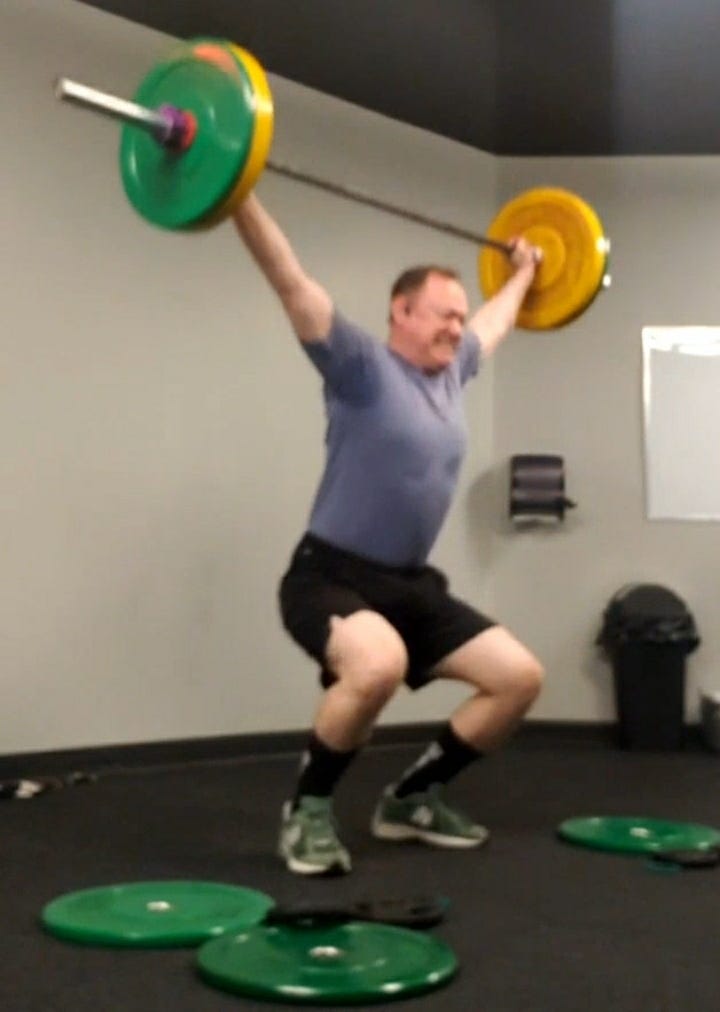
Why Olympic-style weightlifting?
How it became my favorite sport

Physical activity has a host of benefits, including several cognitive perks: it improves concentration, creativity, memory, confidence, emotional stability, posture, body odor, quality of sleep, ability to recover from injury, and the immune system.
I’ve dabbled in several physical activities over the years: cycling, hiking, cross-country skiing, jogging, swimming, and weight training. In 2022, in my mid 40s, I tried doing cleans by copying online instructional videos. A friend gently pointed out my form was “iffy” (it was atrocious) and advised me to seek coaching. This lead to months of stretching my shoulders and slow improvements to my cleans, and later (around January 2023) my first snatches. I have fallen in love with Olympic-style weightlifting, a trinity of movements known as the snatch, clean and jerk. I have dreams about it. I joined a gym with a weightlifting group and coach where I am the oldest member by over a decade, and we can drop our barbell on a wooden platform, producing a loud, satisfying thud. I wish I had started lifting in my teens. I have injured every limb on my body, in one case requiring months of recovery and physiotherapy, and regret none of it. In 2024 I was the oldest participant in a local competition and lifted the least among the men, but still hit new personal records (PRs).
I realized there are several things about the sport that appealed to me:
I found it interesting to observe how cognitively challenging the movements were at first, with many details to try to keep track of, but how, over time, these become automatic. How does the mind achieve such automation of a complex, novel task?
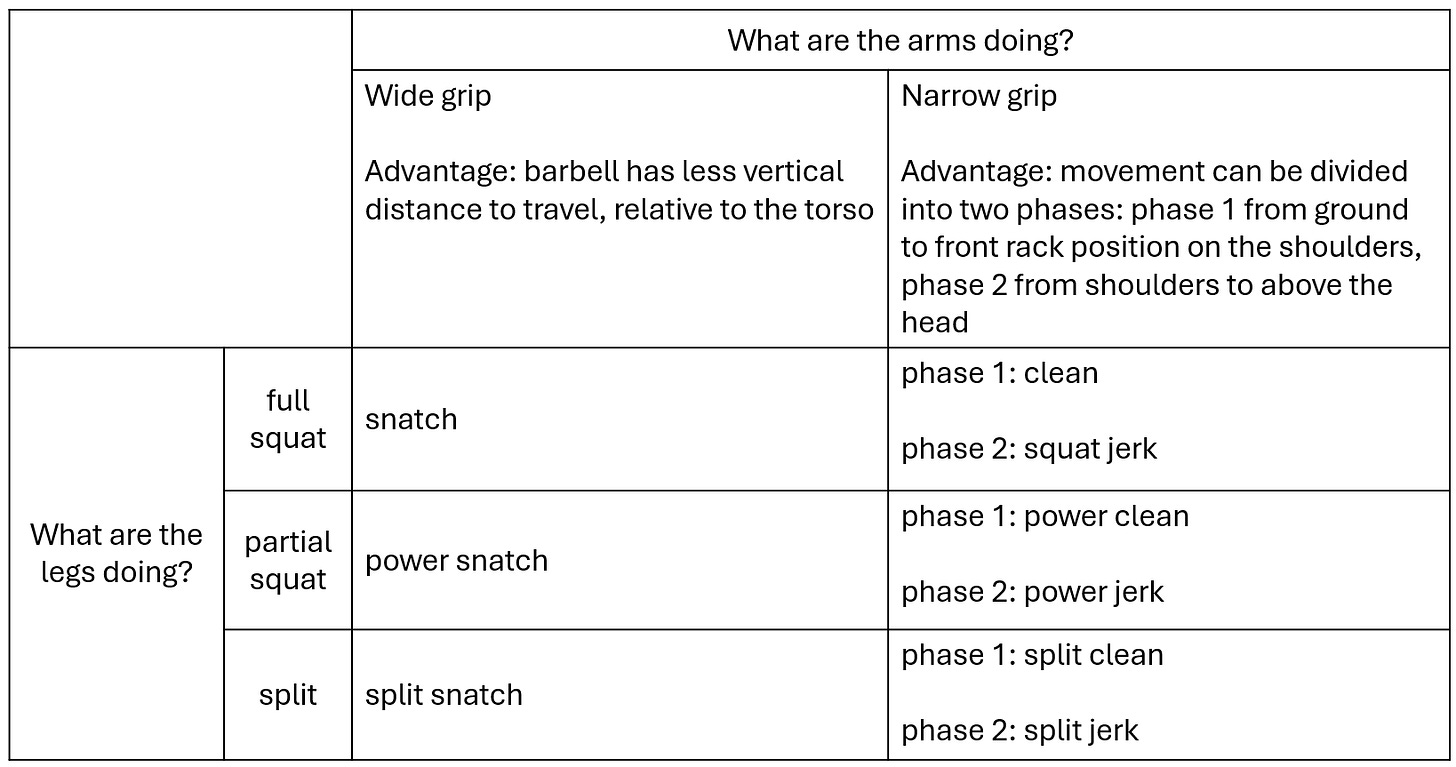
As a simpler intellectual puzzle, one can ask: what is the most efficient movement possible to raise a barbell above one’s head? The snatch, clean and jerk turn out to be ideal solutions, and offer different tradeoffs with respect to grip width, distance travelled by the torso, and height achieved by the bar. There are also a few variants of these movements that are possible: imagine doing a snatch combined with a simultaneous split (of the legs), or imagine doing most of a clean but starting a jerk while standing up from the clean. Here’s my attempt to classify several variants:
I found ways to be creative in my training. I used two tall chairs with straight backs as guides, and practiced lifting a broom stick in such a way as to keep its motion vertical. I watched slow motion videos of athletes and studied the movement of their feet, knees, hips, and shoulders. To overcome my fear of the barbell falling on my head or back, I recorded videos of myself lifting a dowel stick and bailing by dumping it behind myself, allowing me to see there is a large margin for error.
Lifting a heavy weight with arms extended above my head feels like victory, and is a great way to start the day.
Whenever I try to lift an amount of weight that I’ve never attempted before, I don’t know what is going to happen, and I feel ecstatic. My heart is thumping and I have goosebumps.
Weightlifting improves ones posture, as it strengthens the legs, arms, back, and abs.
There is a warm social side to being part of a weightlifting group where others know your name and give you fist bumps, but each of us progresses at our own pace, which appeals to my introversion.
Despite appearances, it is a quite safe sport when done correctly. My injuries have all occurred when I was not under the supervision of a coach and I was being too aggressive.
Here are videos of me doing a snatch of 52.7 kg (116 pounds) and a clean and jerk of 63.6 kg (140 pounds).